.png)
RTF vs BNF vs PNP: Which Trainer Plane Should a Beginner Buy?
By: Michael Snedden On: 15 October 2026
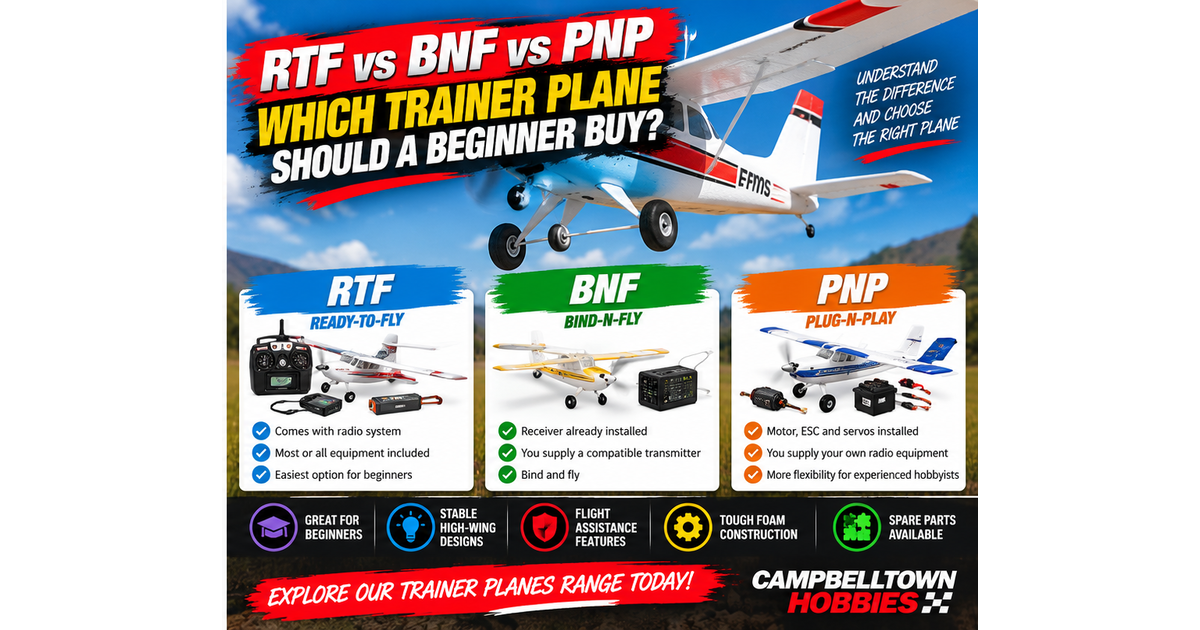

Yep — here’s the finished version with the letters explained immediately, before we get into anything else.
RTF vs BNF vs PNP: Which Trainer Plane Should a Beginner Buy?
Quick Answer: What Do RTF, BNF and PNP Mean?
If you’re buying your first RC plane, these three abbreviations tell you how much equipment comes with the aircraft and what you still need to supply.
- RTF – Ready-to-Fly: The easiest option for most beginners. The aircraft comes with a compatible radio system and most or all of the equipment needed to start flying.
- BNF – Bind-N-Fly: The aircraft has a receiver installed, but you supply a compatible transmitter and bind it to the plane.
- PNP – Plug-N-Play: The motor, ESC and servos are normally installed, but you supply your own transmitter, receiver and usually the battery and charger.
For someone buying their first RC aircraft from scratch, RTF is usually the simplest choice.
BNF makes more sense once you already own a compatible transmitter, while PNP gives experienced hobbyists greater freedom to use their preferred radio and battery equipment.
Campbelltown Hobbies currently stocks beginner trainer planes in different configurations, including RTF and PNP aircraft from FMS and other established RC aircraft brands. Campbelltown Hobbies
Why Do RTF, BNF and PNP Matter?
Two RC planes can look almost identical but require very different equipment before you can fly them.
That is where new pilots can get caught out.
A lower-priced PNP plane may initially look like the better deal, but if you still need to buy a transmitter, receiver, battery and charger, the complete setup can cost considerably more.
The letters are therefore worth checking before you compare prices.
What Does RTF Mean?
RTF means Ready-to-Fly.
For most beginners, this is the easiest place to start.
An RTF package generally includes:
- Aircraft
- Motor
- ESC
- Servos
- Receiver
- Compatible transmitter
Many also include the flight battery and charger, although you should always check the individual product listing.
For example, the FMS Ranger 850mm RTF sold by Campbelltown Hobbies includes the aircraft, motor, ESC/receiver combination, LiPo battery and charger. It also includes beginner, intermediate and manual flight modes. Campbelltown Hobbies
That means a new pilot can concentrate on learning how to fly rather than first having to work out which radio system will operate the aircraft.
What Does BNF Mean?
BNF means Bind-N-Fly.
A BNF aircraft already has a compatible receiver installed, but it normally does not include the transmitter.
You provide your own compatible radio and electronically “bind” it to the receiver in the plane.
BNF starts to make much more sense once you already own a good transmitter.
Rather than accumulating a different transmitter with every aircraft, you can use one compatible radio with multiple models.
For somebody buying their very first RC aircraft, though, an RTF package is usually simpler.
What Does PNP Mean?
PNP means Plug-N-Play.
A PNP plane generally comes with:
- Motor installed
- ESC installed
- Servos installed
You normally supply:
- Transmitter
- Receiver
- Flight battery
- Charger
The current FMS Ranger 1220mm PNP, for example, comes with its motor, ESC and servos but requires the owner to supply the transmitter, receiver, battery and charger. Campbelltown Hobbies
PNP is therefore particularly useful if you already have suitable RC aircraft equipment and want to use your preferred radio and battery system.
Why Can a PNP Plane Be Cheaper Than an RTF Plane?
Because you are buying less equipment.
Campbelltown Hobbies currently lists both RTF and PNP versions of several trainer aircraft, including the FMS Easy Trainer range. Campbelltown Hobbies
The cheaper PNP price does not necessarily mean it is cheaper for a complete beginner.
If you still need to buy everything required to complete it, the total cost can be higher.
That is why the important question is not simply:
How much is the plane?
It is:
What else do I need before I can fly it?
Which Is Best for a Complete Beginner?
For someone starting with no existing RC aircraft equipment:
RTF is usually the best choice.
It removes several purchasing and compatibility decisions at once.
Campbelltown Hobbies currently carries RTF trainers including models such as:
- Prime RC Mini S Cub 450mm
- FMS Easy Trainer 800mm
- FMS Easy Trainer 1280mm
- FMS Super EZ 1220mm
- E-flite Apprentice STS. Campbelltown Hobbies
Once you become more experienced and already own a radio system, BNF and PNP become much more attractive.
What Else Makes a Good Beginner RC Plane?
RTF alone does not automatically make an aircraft a good trainer.
A beginner plane should also have predictable, forgiving flight characteristics.
Look for:
- Stable design
- Manageable speed
- High-wing layout
- Durable lightweight construction
- Flight stabilisation where available
- Easy-to-find replacement parts
A proper trainer gives you time to recognise a mistake and correct it.
Why Are High-Wing RC Planes Popular With Beginners?
A high-wing aircraft has its main wing above the fuselage.
This arrangement is commonly used on trainer aircraft because it tends to provide stable, predictable flight characteristics.
The FMS Ranger is a good example.
Its high-wing design is specifically intended to provide easy flight characteristics, while the 850mm RTF version adds electronic flight control and beginner modes. Campbelltown Hobbies
For somebody learning orientation, throttle control and turns, stability is much more useful than extreme speed.
What Does Flight Stabilisation Do?
Modern beginner planes can use electronic systems to help make the aircraft easier to control.
Depending on the model, assistance can include:
- Self-levelling
- Reduced bank angles
- Beginner flight modes
- Panic recovery
- Return-to-home functions
The FMS Ranger 850mm, for example, includes beginner, intermediate and manual flight modes as well as return-to-home and a flight perimeter function. Campbelltown Hobbies
These features do not replace learning to fly.
They simply give the beginner some assistance while those skills develop.
Does RC Plane Size Matter?
Yes.
A very small trainer is:
- Easy to transport
- Easy to store
- Suitable for smaller flying areas
But a lightweight small aircraft can also be more affected by wind.
A larger trainer can be easier to see in the air and may feel more stable, but requires more flying space and usually costs more.
Campbelltown Hobbies' current trainer range spans compact 450mm aircraft through to much larger models around 1.5 metres in wingspan. Campbelltown Hobbies
Don’t Forget Spare Parts
Beginners have rough landings.
That is part of learning.
Propellers, landing gear and other components can eventually need replacing, which makes parts support worth considering before you buy the aircraft.
Campbelltown Hobbies currently carries hundreds of FMS aircraft spare parts, including components for the Easy Trainer and Super EZ trainer ranges. Campbelltown Hobbies
Buying a trainer with available spare parts can keep a minor accident from ending your flying altogether.
Summary
The easiest way to remember the difference is:
RTF = everything matched and easiest for a first-time buyer.
BNF = aircraft and receiver supplied; bring your compatible transmitter.
PNP = motor, ESC and servos supplied; bring your own radio equipment, battery and charger.
For most people buying their first RC plane, RTF is the logical starting point.
Once you already own a transmitter and understand RC aircraft electronics, BNF and PNP give you more flexibility and can prevent you from repeatedly buying equipment you already have.
Whatever format you choose, look for a genuine trainer with stable handling, flight assistance where appropriate and readily available spare parts.
Browse the Trainer Planes range at Campbelltown Hobbies.
Frequently Asked Questions
What does RTF mean on an RC plane?
RTF means Ready-to-Fly. It normally includes the aircraft and compatible radio system, with many packages also including the flight battery and charger.
What does BNF mean?
BNF means Bind-N-Fly. The aircraft has a receiver fitted, but you supply and bind a compatible transmitter.
What does PNP mean?
PNP means Plug-N-Play. The motor, ESC and servos are usually installed, while you supply the transmitter, receiver, battery and charger.
Which is best for a beginner: RTF, BNF or PNP?
RTF is normally the easiest choice for someone who does not already own RC aircraft equipment.
Is PNP cheaper than RTF?
The aircraft may cost less because less equipment is included, but a first-time buyer may still need to purchase a radio system, battery and charger.
Is BNF better once you own several RC planes?
It can be. A compatible transmitter can potentially be used with multiple BNF aircraft rather than buying another radio with every plane.
What makes a good beginner trainer plane?
Look for stable handling, a forgiving high-wing design, manageable speed, flight stabilisation where useful and readily available replacement parts.
Are spare parts important for a beginner RC plane?
Yes. Propellers, landing gear and other parts can be damaged while learning, so readily available replacement components are a major advantage.


Leave a comment