
What Is the Fastest RC Helicopter?
By: Michael Snedden On: 17 November 2026
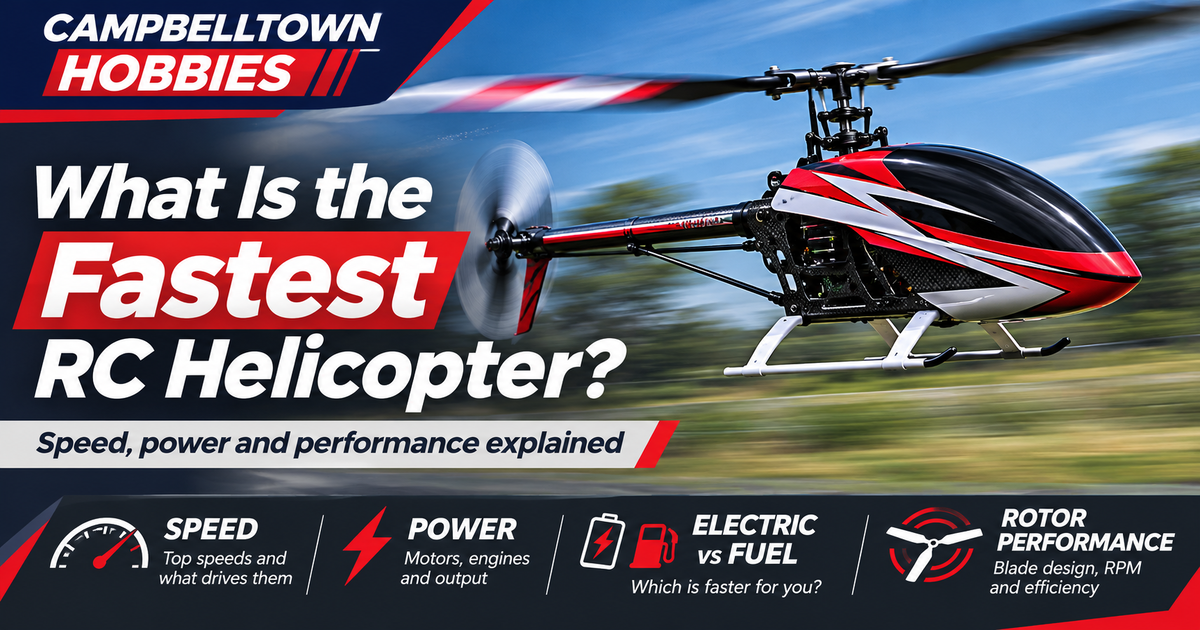

What Is the Fastest RC Helicopter?
The fastest RC helicopters are specialised high-performance model helicopters built for speed rather than beginner flying.
A recognised model-helicopter speed record has exceeded 230 km/h, but that is very different from the helicopters most hobbyists buy and fly.
For normal hobby use, speed depends on the helicopter’s motor, battery or fuel system, rotor speed, blade design, gearing, weight and aerodynamics.
A beginner helicopter is deliberately designed to be stable and manageable. A high-performance collective-pitch helicopter can be dramatically faster, more responsive and more demanding.
So the better question is not simply:
“Which RC helicopter is fastest?”
It is:
“How much performance do you actually want — and can you control it?”
Why RC Helicopter Speed Is Difficult to Compare
RC cars often come with an advertised top speed.
Helicopters are different.
Manufacturers do not always publish a simple maximum forward-speed figure because helicopter performance changes dramatically with setup.
The same helicopter can behave differently depending on:
-
motor and ESC setup
-
battery voltage
-
rotor blades
-
rotor-head speed
-
gearing
-
aircraft weight
-
pitch settings
-
weather conditions
-
pilot setup
That makes it difficult to produce a meaningful list saying one normal retail helicopter is definitely faster than another.
For most hobbyists, the type of helicopter tells you more about its performance than a claimed top-speed number.
Browse the current RC Helicopters available from Campbelltown Hobbies.
What Type of RC Helicopter Is Usually Fastest?
High-performance collective-pitch helicopters are generally capable of much greater speed and manoeuvrability than beginner fixed-pitch helicopters.
Collective pitch allows the pilot to change the pitch angle of the main rotor blades while they are rotating.
This provides much greater control over lift and allows advanced helicopters to perform:
fast forward flight, inverted flight, rapid climbs, aggressive turns and 3D aerobatics.
These helicopters are designed around performance.
That also means they require considerably more skill than a simple beginner helicopter with altitude hold and self-levelling assistance.
Beginner Helicopter vs Performance Helicopter
A beginner RC helicopter is usually designed around stability.
Features may include:
-
electronic stabilisation
-
altitude hold
-
reduced control sensitivity
-
self-levelling
-
assisted take-off and landing
These are excellent features when you are learning.
But stability and maximum speed are not the same objective.
A high-performance helicopter sacrifices some of that simplicity in exchange for much greater control authority and responsiveness.
Campbelltown Hobbies’ current Electric RC Helicopter range illustrates that difference clearly.
The range includes relatively simple beginner helicopters alongside Blade collective-pitch machines and larger Flywing 3D helicopters.
What Factors Affect the Speed of an RC Helicopter?
Motor Power
A more powerful motor can provide greater rotor energy and performance, but motor size alone does not determine speed.
The motor needs to work with the correct battery, ESC, gearing and rotor setup.
Rotor Head Speed
Rotor head speed refers to how quickly the main rotor is rotating.
Higher head speeds can increase responsiveness and available performance, but they also increase mechanical load and energy consumption.
There is always a safe operating range for the helicopter and blades.
Rotor Blade Design
Blade length, width, weight and aerodynamic profile all affect performance.
A blade optimised for aggressive 3D flying may behave differently from one designed around stability or scale flight.
Pitch Setup
Collective-pitch helicopters allow the angle of the rotor blades to change.
The available positive and negative pitch has a major influence on climb performance and aerobatic capability.
Weight
A lighter helicopter does not automatically mean a faster helicopter, but unnecessary weight affects acceleration, manoeuvrability and power requirements.
Aerodynamics
Scale helicopter bodies can create more aerodynamic drag than an exposed performance-oriented frame.
That is one reason a beautifully detailed scale helicopter and a dedicated 3D helicopter may feel completely different despite using powerful electric systems.
Are Electric or Fuel-Powered RC Helicopters Faster?
There is no simple answer.
Electric helicopters have become extremely powerful.
Modern brushless motors and LiPo batteries can deliver enormous power immediately, which makes electric helicopters capable of serious performance.
Nitro and petrol helicopters still appeal to many enthusiasts for other reasons, including engine operation, sound, longer refuelling-style sessions and the mechanical side of the hobby.
Power source alone does not decide which helicopter is faster.
An electric performance helicopter can be much faster than a fuel-powered scale helicopter, while a highly tuned fuel helicopter may outperform a basic electric model.
The complete aircraft setup matters more.
Does a Bigger Battery Make an RC Helicopter Faster?
Not automatically.
Increasing battery voltage can increase performance only when the motor, ESC and helicopter are designed to handle it.
Installing an unsuitable battery can damage components or create an unsafe setup.
A larger-capacity battery also adds weight.
That may increase flight time but can change:
-
centre of gravity
-
manoeuvrability
-
motor load
-
rotor response
Always use the battery specification recommended for the helicopter or an upgrade combination known to be compatible with that model.
Can You Make an RC Helicopter Fly Faster?
Yes, but this is where experienced setup becomes important.
Possible performance changes can involve gearing, motor choice, battery setup, ESC programming, rotor blades, pitch settings and aircraft weight.
But increasing performance also increases loads on the helicopter.
That means components such as:
main gears, shafts, rotor head, bearings, blades and electronics
need to remain within their design limits.
Simply chasing more rotor speed is not a sensible upgrade strategy.
A correctly set-up helicopter that performs reliably is much better than a heavily modified helicopter operating beyond what its components can safely handle.
Why High Speed Makes RC Helicopters Harder to Fly
Speed dramatically reduces your reaction time.
When a helicopter is moving slowly, you have time to see what it is doing and correct the flight path.
At high speed, the aircraft can cover a large distance before you react.
Orientation also becomes more difficult as the helicopter moves further away.
This is why someone buying their first RC helicopter should not choose purely on speed.
If you are new to helicopters, read What’s the Easiest RC Helicopter to Fly?.
A stabilised beginner helicopter makes far more sense while you are learning orientation, hovering and basic circuits.
Speed vs 3D Performance
Another common misconception is that the fastest helicopter must also be the best-performing helicopter.
Not necessarily.
Some pilots want high forward speed.
Others want:
-
extreme climb performance
-
rapid direction changes
-
inverted flight
-
tic-tocs
-
funnels
-
flips
-
rolls
-
other 3D manoeuvres
A helicopter built for aggressive 3D flying is tuned around responsiveness and power delivery rather than simply achieving the highest possible straight-line speed.
That is why experienced helicopter pilots often talk more about head speed, cyclic response, pitch and power-to-weight ratio than maximum kilometres per hour.
Does Faster Mean Better?
No.
A very fast helicopter may be completely wrong for the person flying it.
For a beginner, slower and more stable is usually better.
For someone progressing into collective pitch, controllability and predictable handling are extremely important.
For an experienced 3D pilot, strong power and rapid response may be exactly what they want.
The best helicopter is the one that matches your experience and the type of flying you enjoy.
Our guide What’s the Best Remote Control Helicopter to Buy? looks at that choice in more detail.
What About Flight Time?
Increasing performance usually comes with a trade-off.
High rotor speeds and aggressive flying consume more energy.
A pilot flying hard 3D manoeuvres can use a battery much faster than someone cruising or hovering with the same aircraft.
If endurance matters to you as much as performance, see How Long Do RC Helicopters Fly?.
Maximum speed and maximum flight time rarely occur together.
Why Buy an RC Helicopter From Campbelltown Hobbies?
Choosing an RC helicopter is not just about comparing specifications.
There is a huge difference between:
a beginner RTF helicopter, a stabilised intermediate helicopter, a scale model and a high-performance collective-pitch machine.
Campbelltown Hobbies carries RC helicopters across these different levels, along with batteries, radio equipment, servos, spare parts and accessories.
That means you can choose a helicopter based on your actual experience rather than simply buying the most powerful model available.
If you are unsure, speak with the Campbelltown Hobbies team about:
where you intend to fly, how much helicopter experience you already have, whether you want RTF or BNF, whether your priority is stability, scale appearance, aerobatics or outright performance, and what equipment you already own.
You can also browse the Ready-to-Fly RC Helicopters range if you want a simpler complete setup.
For somebody moving into higher-performance helicopters, parts support becomes even more important.
High-performance RC helicopters are machines that need proper inspection, setup and maintenance.
Buying through a specialist RC hobby store gives you somewhere to return when you need replacement parts, setup advice or your next step up in performance.
Summary
The fastest RC helicopters are specialised performance aircraft capable of speeds far beyond ordinary beginner helicopters.
But maximum speed alone is not a useful way to choose an RC helicopter.
Performance depends on the motor, battery or fuel system, rotor speed, blades, gearing, pitch setup, weight and aerodynamics.
Modern electric collective-pitch helicopters can deliver extremely high performance, while beginner helicopters deliberately prioritise stability and controllability.
If you are starting out, choose a helicopter you can control confidently.
If you already have experience, then factors such as rotor-head speed, power, cyclic response and 3D capability become much more important.
Campbelltown Hobbies stocks beginner through to advanced RC helicopters and can help match the aircraft to your experience and the type of flying you actually want to do.
Frequently Asked Questions
What is the fastest RC helicopter?
Specialised model helicopters have exceeded 230 km/h in recorded speed attempts. Normal hobby helicopters vary substantially and are not usually sold with a simple guaranteed top-speed figure.
How fast can an RC helicopter fly?
It depends on the helicopter. Small beginner models are designed for manageable flight, while advanced collective-pitch helicopters can fly dramatically faster.
Which RC helicopters are fastest?
High-performance collective-pitch helicopters designed for advanced flying are generally much faster than fixed-pitch beginner helicopters.
Are electric RC helicopters faster than petrol helicopters?
Either can be fast. Modern brushless electric systems can provide enormous power, so the overall helicopter design and setup matter more than the power source alone.
Does a bigger battery make an RC helicopter faster?
Not necessarily. Voltage, capacity, weight and component compatibility all matter. Only use a battery setup suitable for the helicopter.
Can you upgrade an RC helicopter to make it faster?
Some helicopters can be tuned through motor, gearing, battery, ESC and rotor changes, but all components must remain within their safe operating limits.
Are fast RC helicopters hard to fly?
Yes. Higher speed reduces reaction time and makes orientation and control more demanding.
What is the best fast RC helicopter for a beginner?
A beginner should generally prioritise stability rather than maximum speed. Start with a stabilised Ready-to-Fly helicopter and progress to more capable collective-pitch models as your skills improve.
Where can I buy an RC helicopter in Australia?
Campbelltown Hobbies stocks beginner, Ready-to-Fly, electric and advanced RC helicopters, along with batteries, radio equipment, parts and accessories.


Leave a comment