
What Makes a Good RC Rock Crawler?
By: Michael Snedden On: 30 October 2026
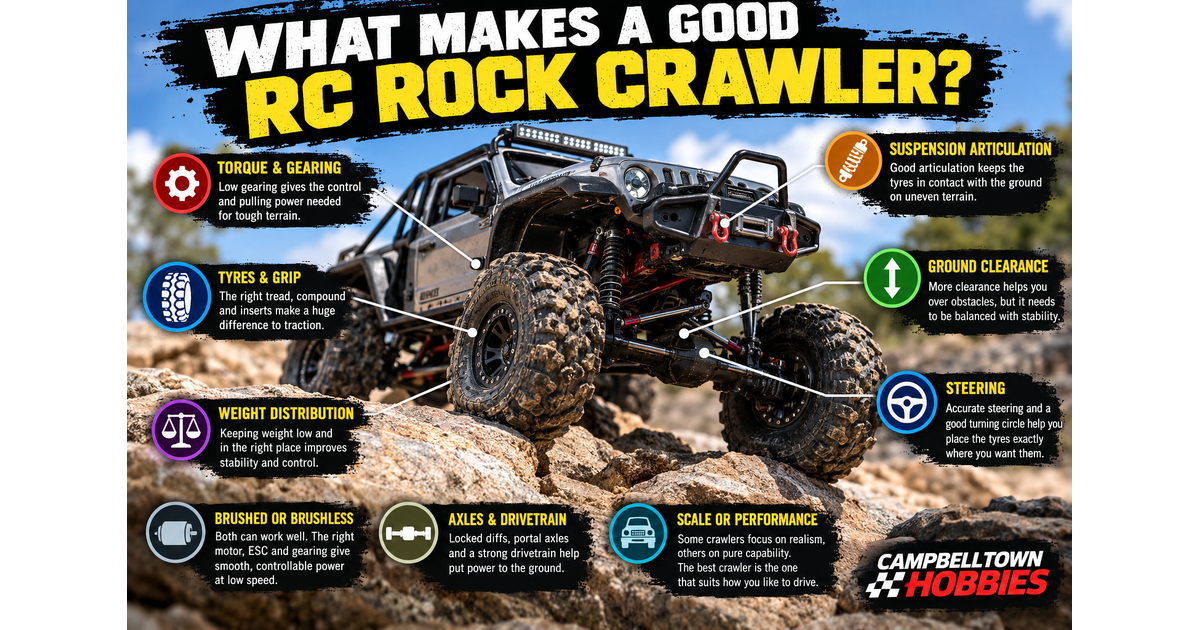

A good RC rock crawler is not defined by outright speed. What matters most is low-speed control, torque, grip, suspension movement, ground clearance, gearing and weight distribution.
The best crawler is one that can put its power to the ground smoothly, keep its tyres in contact with uneven terrain and remain controlled when climbing, descending or crossing obstacles.
That is why a crawler that looks slow beside a high-powered basher can be far more capable once the terrain gets difficult.
Speed Isn’t the Point
RC cars are often compared by speed.
For rock crawling, that is almost the wrong measurement.
A crawler needs enough wheel speed when required, but its real strength is being able to move slowly and predictably.
When climbing rocks or working through a technical section, sudden power can break traction or throw the vehicle off line.
Good throttle control lets the driver feed in exactly as much power as the tyres can use.
That makes gearing, motor choice and ESC response just as important as maximum motor output.
Torque Matters More Than Top Speed
Rock crawlers need torque because the drivetrain is constantly working against resistance.
The vehicle may be:
-
climbing a steep rock face
-
pushing a tyre against an obstacle
-
moving from a standing start on an incline
-
turning large tyres at very low speed
-
working through loose dirt, mud or uneven terrain
Lower gearing helps turn motor power into controlled wheel torque.
For serious crawling, a vehicle that delivers power smoothly at walking pace can be much more useful than one capable of very high speed.
Tyres Can Transform a Crawler
Tyres are one of the biggest factors in crawler performance.
They need to conform to uneven surfaces and provide grip on rock, dirt and other changing terrain.
Important factors include:
-
tread pattern
-
rubber compound
-
tyre diameter
-
tyre width
-
foam inserts
-
sidewall flexibility
-
wheel weight and design
A crawler can have excellent suspension and plenty of torque, but if the tyres cannot find traction, the rest of the setup becomes much less effective.
This is also why changing tyres can sometimes make a bigger difference than increasing motor power.
Campbelltown Hobbies has previously covered this in the RC Car Tyres: How to Choose the Right Tyres for Your RC Car guide, including the differences between crawler tyres and tyres designed for faster RC vehicles.
Suspension Articulation Keeps the Tyres Working
A good crawler needs suspension that allows the wheels to move independently over uneven terrain.
This movement is often described as articulation.
When one wheel climbs over a rock, the suspension should allow the other wheels to remain in useful contact with the ground rather than lifting unnecessarily.
More articulation is not automatically better, however.
Too much unrestricted movement can make the vehicle unpredictable.
A well-designed crawler balances:
wheel travel + chassis control + tyre contact.
The objective is not simply to make the suspension move as far as possible.
It is to keep the vehicle stable while allowing the tyres to follow the terrain.
Ground Clearance Helps — Up to a Point
Ground clearance allows a crawler to move over rocks, ledges and uneven ground without constantly catching the underside of the chassis.
However, raising the entire vehicle also raises its centre of gravity.
That can make it easier to roll on side slopes or steep climbs.
This is why good crawler design is a compromise.
You want enough clearance underneath the vehicle without putting unnecessary weight high above the axles.
Portal Axles
Some RC crawlers use portal axles.
Instead of the wheel centre sitting directly in line with the axle housing, portal gears move the wheel hub lower.
This can provide additional clearance underneath the axle housing without lifting the whole chassis by the same amount.
Portal axles are therefore particularly useful where axle clearance is important.
They are not essential for every crawler, but they are one of the design features worth understanding when comparing models.
Weight Distribution Makes a Big Difference
Where the weight sits can matter almost as much as how much the crawler weighs.
A vehicle carrying too much weight high in the body may look impressive but can become unstable on steep or uneven terrain.
Crawler setups generally benefit from keeping weight lower in the chassis.
Drivers sometimes also adjust front-to-rear weight balance depending on how and where the vehicle is used.
Extra front bias can help during climbs, although every change affects another part of the vehicle's behaviour.
Adding weight everywhere is not automatically an upgrade.
The aim is useful weight in the right place.
Wheelbase Changes How a Crawler Behaves
Wheelbase affects both stability and manoeuvrability.
A longer wheelbase can provide more stability on climbs and help bridge larger gaps.
A shorter wheelbase can make it easier to negotiate tight turns and some sharp changes in terrain.
Neither is universally better.
The right choice depends on where you drive and what type of crawling you enjoy.
This is one reason scale crawlers, trail trucks and more competition-focused machines can feel very different even when their basic specifications appear similar.
Brushed or Brushless for a Rock Crawler?
Both can work extremely well.
Traditionally, brushed motors have been popular in crawlers because they can provide excellent low-speed control at relatively low cost.
Modern brushless crawler systems have changed the equation considerably.
A well-designed brushless system can offer:
-
excellent low-speed control
-
strong torque
-
greater efficiency
-
less motor maintenance
-
useful wheel speed when needed
The key point is that brushless does not simply mean fast.
Motor characteristics, ESC programming, gearing and the entire vehicle setup determine how the crawler behaves.
We covered the wider differences in Brushed vs Brushless RC Cars: What’s the Difference?
4WD Is Only the Beginning
Most serious RC crawlers use four-wheel drive, but simply driving all four wheels does not make a vehicle a great crawler.
The drivetrain also needs to deliver power effectively.
Factors can include:
-
gearing
-
differential setup
-
axle design
-
driveshaft angles
-
transmission layout
-
steering geometry
Some crawlers use locked differentials so both wheels on an axle continue turning together.
This can be extremely useful on uneven terrain where one tyre may have little or no grip.
The disadvantage is increased tyre scrub and a wider turning tendency on high-grip surfaces.
Again, crawler design involves compromise.
Steering Matters More Than Many People Expect
On technical terrain, the ability to position the front tyres accurately can be just as important as power.
A crawler with a poor turning circle or weak steering servo can struggle even if the rest of the chassis is capable.
Useful crawler steering depends on:
-
steering angle
-
servo torque
-
linkage geometry
-
tyre clearance
-
front axle design
More steering angle can help enormously when navigating tight rock sections or repositioning the vehicle without reversing repeatedly.
Scale Crawlers vs Pure Performance
Not every crawler owner wants the same thing.
Some enthusiasts enjoy highly realistic vehicles based on real 4WDs.
Others care mainly about capability.
Scale details may include:
-
licensed bodies
-
realistic wheels and tyres
-
lights
-
roof racks
-
accessories
-
detailed interiors
-
realistic suspension and chassis layouts
These features can make a crawler much more enjoyable to own and drive.
But some scale accessories also add weight — often high on the vehicle.
A beautifully detailed trail truck and a performance-focused rock crawler can therefore be designed around very different priorities.
Neither approach is wrong.
RTR or Build Your Own?
Ready-to-run crawlers have become extremely capable.
An RTR crawler is a good option if you want to start driving immediately and then modify the vehicle as you learn what you want from it.
More experienced hobbyists may prefer a kit or a platform that provides plenty of upgrade options.
Common crawler upgrades include:
-
tyres
-
wheels
-
inserts
-
servos
-
motors
-
ESCs
-
suspension components
-
links
-
gearing
-
axle components
-
body accessories
The advantage of starting with a well-supported platform is that you can change the vehicle gradually rather than replacing everything at once.
Parts support matters here as well. Campbelltown Hobbies also covers this in Where Can I Buy RC Car Parts?
So What Actually Makes a Good RC Crawler?
There is no single specification that tells you.
A good crawler brings several things together:
Grip.
Torque.
Low-speed control.
Ground clearance.
Articulation.
Steering.
Weight distribution.
Drivetrain design.
And most importantly, those elements need to work together.
The crawler with the biggest motor, tallest suspension or largest tyres is not automatically the best one.
A balanced vehicle that stays controlled and keeps finding traction will usually get much further.
Summary
A good RC rock crawler is designed around control rather than outright speed.
Torque and gearing allow the vehicle to move slowly over difficult terrain, while tyres provide grip and suspension articulation helps keep those tyres on the ground.
Ground clearance, steering, wheelbase and weight distribution all affect how capable the vehicle becomes.
There are also very different styles of crawler, from realistic scale 4WDs and trail trucks through to vehicles built primarily for technical crawling performance.
For many enthusiasts, that is part of the attraction.
Crawling is not just about buying a vehicle and driving it. It gives you endless opportunities to change the setup, test the result and work out what makes the vehicle better on the terrain you actually drive.
Frequently Asked Questions
What is the most important feature of an RC rock crawler?
There is no single most important component, but grip and low-speed control are fundamental. A crawler needs to deliver usable torque while keeping its tyres in contact with the terrain.
Are brushless motors good for RC crawlers?
Yes. Modern brushless crawler systems can provide excellent low-speed control and strong torque. Brushed systems are still popular and can also perform extremely well.
Do RC crawlers need locked differentials?
Many crawlers use locked or highly restricted differentials because they help maintain drive when one tyre loses traction. The best setup depends on the type of vehicle and terrain.
Are bigger tyres always better for crawling?
No. Larger tyres can improve clearance and obstacle capability, but they can also affect gearing, steering, motor load and centre of gravity. They need to suit the vehicle.
What is the difference between a trail truck and a rock crawler?
There is considerable overlap. Trail trucks often place more emphasis on realistic driving and scale appearance, while more specialised rock crawlers may prioritise technical terrain performance.
Is an RTR rock crawler worth buying for an experienced RC hobbyist?
Absolutely. Modern RTR crawlers can be very capable platforms, and many experienced hobbyists enjoy tuning and upgrading them rather than building completely from scratch.
What are the best upgrades for an RC crawler?
Tyres are often one of the most noticeable upgrades. Steering servos, wheels and inserts, suspension setup, gearing and electronics can also make significant differences depending on the vehicle.
Is RC rock crawling difficult?
It is easy to start but difficult to master. Driving slowly over technical terrain requires careful throttle control, steering and choosing the right line through obstacles.


Leave a comment