
Which Is Easier to Fly: an RC Plane or Helicopter?
By: Michael Snedden On: 29 October 2026
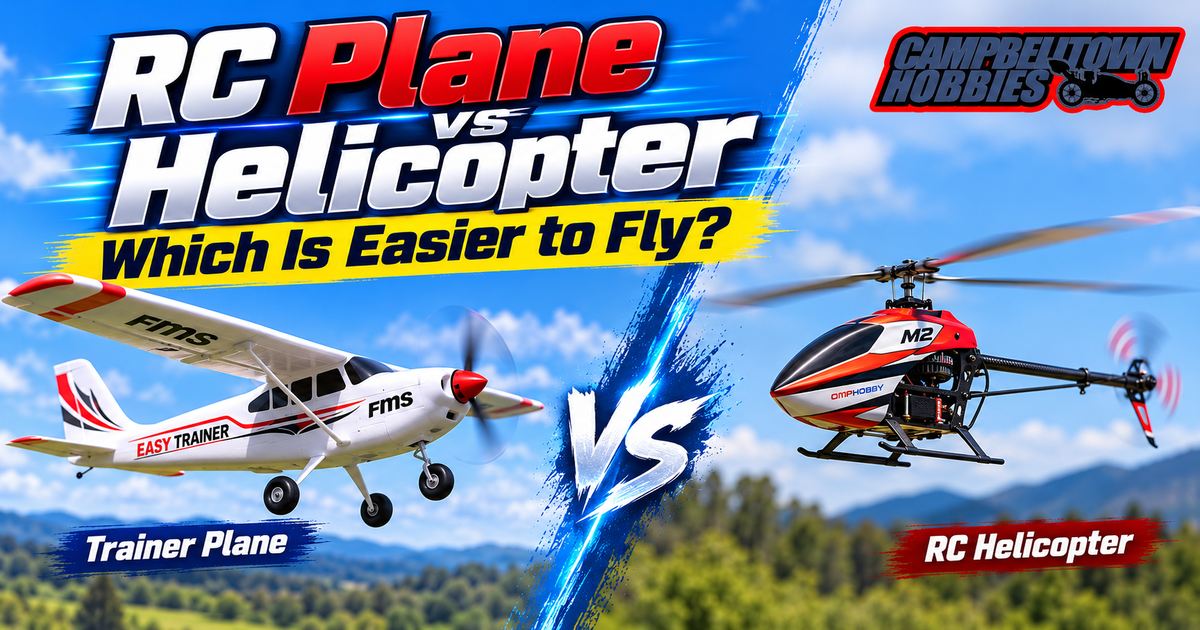

For most complete beginners, a stable RC trainer plane is generally easier to learn to fly than a traditional RC helicopter.
A trainer plane naturally moves forward and is designed to remain stable in flight, while a helicopter has to be actively controlled while hovering, climbing, turning and moving in several directions.
Modern electronic stabilisation has narrowed the gap considerably. Beginner Ready-to-Fly helicopters with 6-axis stabilisation and altitude hold are much easier than older RC helicopters, so either can now be a realistic first aircraft.
Campbelltown Hobbies carries both beginner trainer planes and Ready-to-Fly helicopters designed to make learning radio-controlled flight more approachable.
Why Are RC Planes Usually Easier for Beginners?
A trainer plane has an important advantage: once it is flying at a suitable speed, the wings generate lift and the aircraft naturally wants to keep moving forward.
Most beginner trainer planes also use a high-wing layout.
Campbelltown Hobbies describes trainer planes as having stable flight characteristics, forgiving handling and durable construction, with high-wing designs commonly used because they improve stability during take-off, cruising and landing.
That gives a new pilot more time to recognise and correct a mistake.
Why Are RC Helicopters Traditionally Harder?
A helicopter does not rely on forward movement to remain airborne.
It can hover, climb vertically, turn within a confined space and move forwards, backwards and sideways.
That manoeuvrability is one of the biggest attractions of helicopters, but it also means the pilot has more happening at once.
A new pilot needs to manage altitude, direction and orientation while constantly keeping the helicopter under control.
Older helicopters demanded almost continuous corrections.
That is why traditional RC helicopter flying developed a reputation for having a steep learning curve.
Have Modern RC Helicopters Become Easier?
Yes — substantially.
Electronic stabilisation has changed beginner helicopter flying.
Current Ready-to-Fly helicopters at Campbelltown Hobbies include models with features such as 6-axis stabilisation and altitude hold.
For example, the Twister BO-105 Scale 250 combines both features, while beginner UDI helicopters offer inexpensive RTF entry points.
These systems reduce the amount of constant correction required from the pilot.
They do not remove the need to learn, but they can make the first flights far less intimidating.
Which Is Easier to Control?
For basic forward flying, a trainer plane generally wins.
Once it is moving and correctly trimmed, you can concentrate on making smooth turns and controlling height.
A helicopter is easier in one very specific sense: it can hover in one area.
You do not need the same amount of horizontal flying space.
But hovering itself requires good orientation and control.
A stabilised beginner helicopter can make that much easier, particularly when altitude hold is included.
What Happens If You Stop Moving?
This is one of the biggest differences.
A plane needs airflow over its wings to keep producing enough lift.
Slow down too far and the aircraft can stall.
A helicopter can simply hover.
That makes helicopters excellent for practising in a confined flying area, but you still have to control the aircraft while it remains airborne.
How Long Does It Take to Learn?
There is no fixed answer.
Some people quickly understand aircraft orientation while others need considerably more practice.
A beginner plane usually lets a new pilot progress through straight flying, gentle turns and circuits relatively quickly.
With a helicopter, a good first goal is simply learning to hover consistently with the tail pointing towards you.
Once that becomes comfortable, you can practise turning, sideways movement and flying with different orientations.
The aircraft and its electronic assistance make a large difference to the learning curve.
Which Is Better for a Small Flying Area?
A small stabilised helicopter can be the better option because it can hover and manoeuvre without needing to fly large circuits.
Campbelltown Hobbies notes that smaller RTF helicopters can suit indoor flying or calm outdoor conditions.
An RC plane normally needs more open space because it must keep moving.
Even a small trainer needs enough room to turn safely and recover from mistakes.
Which Is Better Outdoors?
Both can be excellent outdoors.
Trainer planes are particularly enjoyable when you have a large clear flying area.
Small lightweight helicopters can be more affected by wind, while larger helicopters can handle outdoor conditions better but generally become more advanced machines.
The correct choice depends on aircraft size as much as whether it is a plane or helicopter.
Which Is Better for a Complete Beginner?
If someone simply says, “I want to learn RC flying,” I would generally start with a trainer plane.
A high-wing electric trainer with flight stabilisation provides a forgiving introduction to orientation, throttle and basic flight.
If the person specifically wants to learn helicopter flying, though, there is no reason to buy a plane first.
Start with a small Ready-to-Fly helicopter that includes stabilisation and simple controls.
Campbelltown Hobbies currently lists beginner RTF helicopters from around $60, alongside more sophisticated stabilised models.
What About Spare Parts?
Whichever aircraft you choose, replacement parts matter.
Learning involves imperfect landings.
Planes may need replacement propellers, landing gear or other components.
Helicopters have high-speed rotating parts including blades, shafts, gears, bearings and linkages that can wear or be damaged. Campbelltown Hobbies carries dedicated helicopter spare parts as well as plane parts.
A model with good parts support is much easier to keep flying after a minor accident.
Are RC Helicopters Still Popular?
Yes.
Modern stabilisation has made helicopters far more accessible than they once were, while advanced collective-pitch machines continue to appeal to experienced pilots who enjoy aerobatic flying and mechanical setup.
Campbelltown Hobbies currently has Ready-to-Fly, electric, fuel-powered and toy helicopter categories, alongside extensive parts support.
Plane or Helicopter: Which Should You Choose?
Choose an RC plane if the idea of take-offs, circuits, gliding and traditional fixed-wing flight appeals to you.
Choose a helicopter if hovering, vertical movement and precise manoeuvring are what interest you.
For pure learning difficulty, the trainer plane generally has the advantage.
For somebody specifically fascinated by helicopters, modern electronic assistance means you no longer need to learn on the difficult machines of the past.
Summary
For most beginners, an RC trainer plane is easier to learn because it is naturally stable and the pilot has fewer controls to manage simultaneously.
RC helicopters require more active control, particularly while hovering and changing orientation.
However, modern beginner helicopters with 6-axis stabilisation, altitude hold and other electronic assistance have made the learning curve much more manageable.
The best first aircraft is therefore not simply the easiest one.
It is the one you actually want to learn to fly.
Browse Trainer Planes and RC Helicopters at Campbelltown Hobbies to compare beginner-friendly aircraft and Ready-to-Fly options.
Frequently Asked Questions
Is an RC plane or helicopter easier for beginners?
A stable trainer plane is generally easier for most beginners, although electronic stabilisation has made modern beginner helicopters much easier to fly.
Are RC helicopters difficult to fly?
Advanced helicopters can be demanding, but beginner RTF models with stabilisation and altitude hold can be surprisingly manageable.
Can an RC helicopter hover?
Yes. Unlike a plane, a helicopter can remain approximately stationary in the air, climb vertically and move in multiple directions.
How long can an RC helicopter fly?
Flight time varies by model and battery. One current Twister BO-105 RTF model is listed with a flight duration of about 15 minutes.
Are RC helicopters still popular?
Yes. They range from inexpensive beginner models to sophisticated electric and fuel-powered aircraft for experienced pilots.
Is an RC helicopter better than a drone?
They provide different experiences. Drones prioritise electronic stability, while helicopters provide traditional rotorcraft flying and a different style of control.
Do beginners need an RTF aircraft?
RTF is usually the simplest choice because the main components and radio equipment are already matched.


Leave a comment