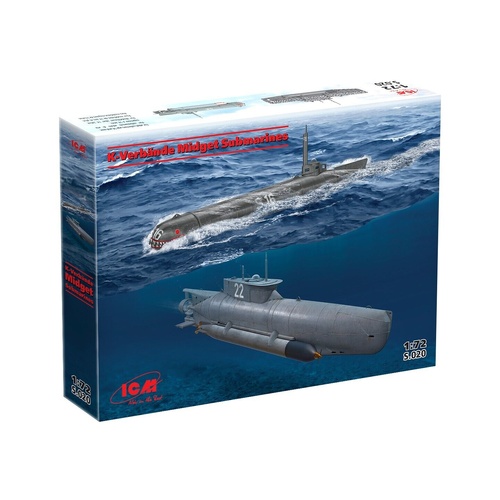
ICM 1/72 K-VerbÌ_nde Midget Submarines ('Seehund' and 'Molch') Plastic Model Kit
SKU: ICMS020
$49.99

or 4 payments of $25.00 with
 Info
Description
WWII German attack aircraft
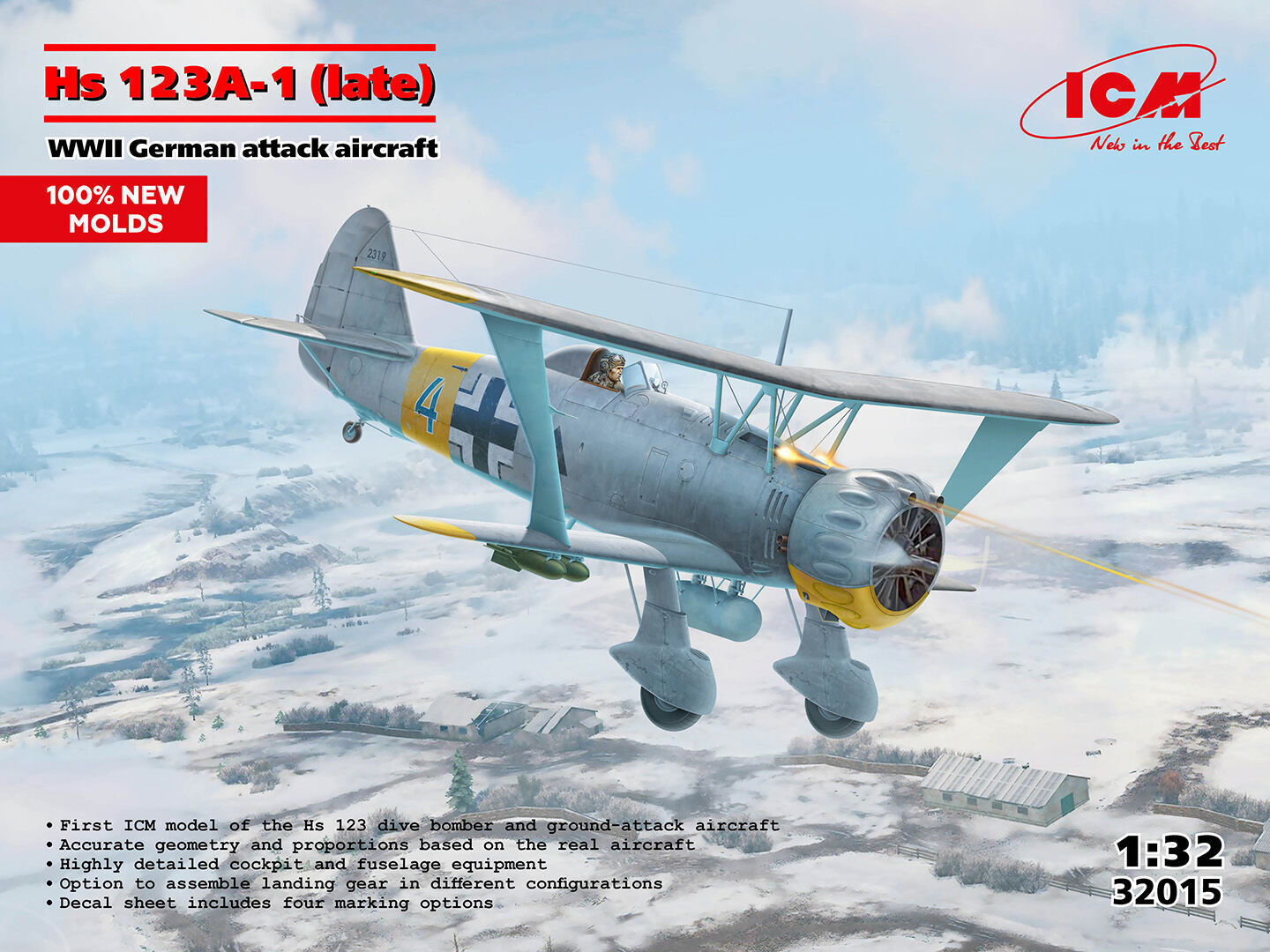
In 1933, at the initiative of the German Reich Ministry of Aviation, development began on a specialized dive bomber. In the spring of 1935, the prototype developed by Henschel Flugzeug-Werke A.G. made its first flight. This prototype was designated Hs-123 V1. The aircraft received positive evaluations, and in September 1936, serial production of the Hs 123A-1 modification commenced. The new attack aircraft was equipped with a BMW 132 engine, delivering 880 horsepower at takeoff.
As its built-in armament, it carried two synchronized machine guns mounted behind the instrument panel, firing through special ducts in the engine cowling. The lower wing, fitted with flaps, had four hardpoints for 50-kg bombs, and a single 250-kg bomb could be mounted under the fuselage. The Hs 123s were deployed with units assigned to direct infantry support, and they were also widely used in training units.
At the start of World War II, these aircraft were used during the invasion of Poland, and shortly after in France and the Balkans, where they demonstrated high survivability against anti-aircraft fire, even withstanding direct hits. Later, the Hs 123 saw action in Luftwaffe units during operations against the Soviet Union. Despite its outdated design, the aircraft remained in service with the German Air Force until as late as 1944.
Description
SpecificationsWWII German attack aircraft
In 1933, at the initiative of the German Reich Ministry of Aviation, development began on a specialized dive bomber. In the spring of 1935, the prototype developed by Henschel Flugzeug-Werke A.G. made its first flight. This prototype was designated Hs-123 V1. The aircraft received positive evaluations, and in September 1936, serial production of the Hs 123A-1 modification commenced. The new attack aircraft was equipped with a BMW 132 engine, delivering 880 horsepower at takeoff.
As its built-in armament, it carried two synchronized machine guns mounted behind the instrument panel, firing through special ducts in the engine cowling. The lower wing, fitted with flaps, had four hardpoints for 50-kg bombs, and a single 250-kg bomb could be mounted under the fuselage. The Hs 123s were deployed with units assigned to direct infantry support, and they were also widely used in training units.
At the start of World War II, these aircraft were used during the invasion of Poland, and shortly after in France and the Balkans, where they demonstrated high survivability against anti-aircraft fire, even withstanding direct hits. Later, the Hs 123 saw action in Luftwaffe units during operations against the Soviet Union. Despite its outdated design, the aircraft remained in service with the German Air Force until as late as 1944.
WWII German attack aircraft
In 1933, at the initiative of the German Reich Ministry of Aviation, development began on a specialized dive bomber. In the spring of 1935, the prototype developed by Henschel Flugzeug-Werke A.G. made its first flight. This prototype was designated Hs-123 V1. The aircraft received positive evaluations, and in September 1936, serial production of the Hs 123A-1 modification commenced. The new attack aircraft was equipped with a BMW 132 engine, delivering 880 horsepower at takeoff.
As its built-in armament, it carried two synchronized machine guns mounted behind the instrument panel, firing through special ducts in the engine cowling. The lower wing, fitted with flaps, had four hardpoints for 50-kg bombs, and a single 250-kg bomb could be mounted under the fuselage. The Hs 123s were deployed with units assigned to direct infantry support, and they were also widely used in training units.
At the start of World War II, these aircraft were used during the invasion of Poland, and shortly after in France and the Balkans, where they demonstrated high survivability against anti-aircraft fire, even withstanding direct hits. Later, the Hs 123 saw action in Luftwaffe units during operations against the Soviet Union. Despite its outdated design, the aircraft remained in service with the German Air Force until as late as 1944.
| SKU | ICM32015 |
| Barcode # | 4823044411443 |
| Brand | ICM |
| Shipping Weight | 0.0300kg |
| Shipping Width | 0.080m |
| Shipping Height | 0.010m |
| Shipping Length | 0.080m |
In-stock items and stock levels are subject to change. If a stock error occurs, our team will notify you. Products may have different processing times depending on their stock location. Please check your cart for each item’s estimated dispatch time before completing your order. Processing time is separate from the carrier’s delivery time. Orders containing items from multiple locations will be dispatched once all items have arrived at our Campbelltown store and are ready to be sent together. Orders containing LiPo batteries, fuel or rocket engines will be sent via Standard Post. If you select Signature Not Required and your parcel is lost after being recorded as delivered, Campbelltown Hobbies cannot be held responsible for its replacement.