.png)

SKU: ICM48408

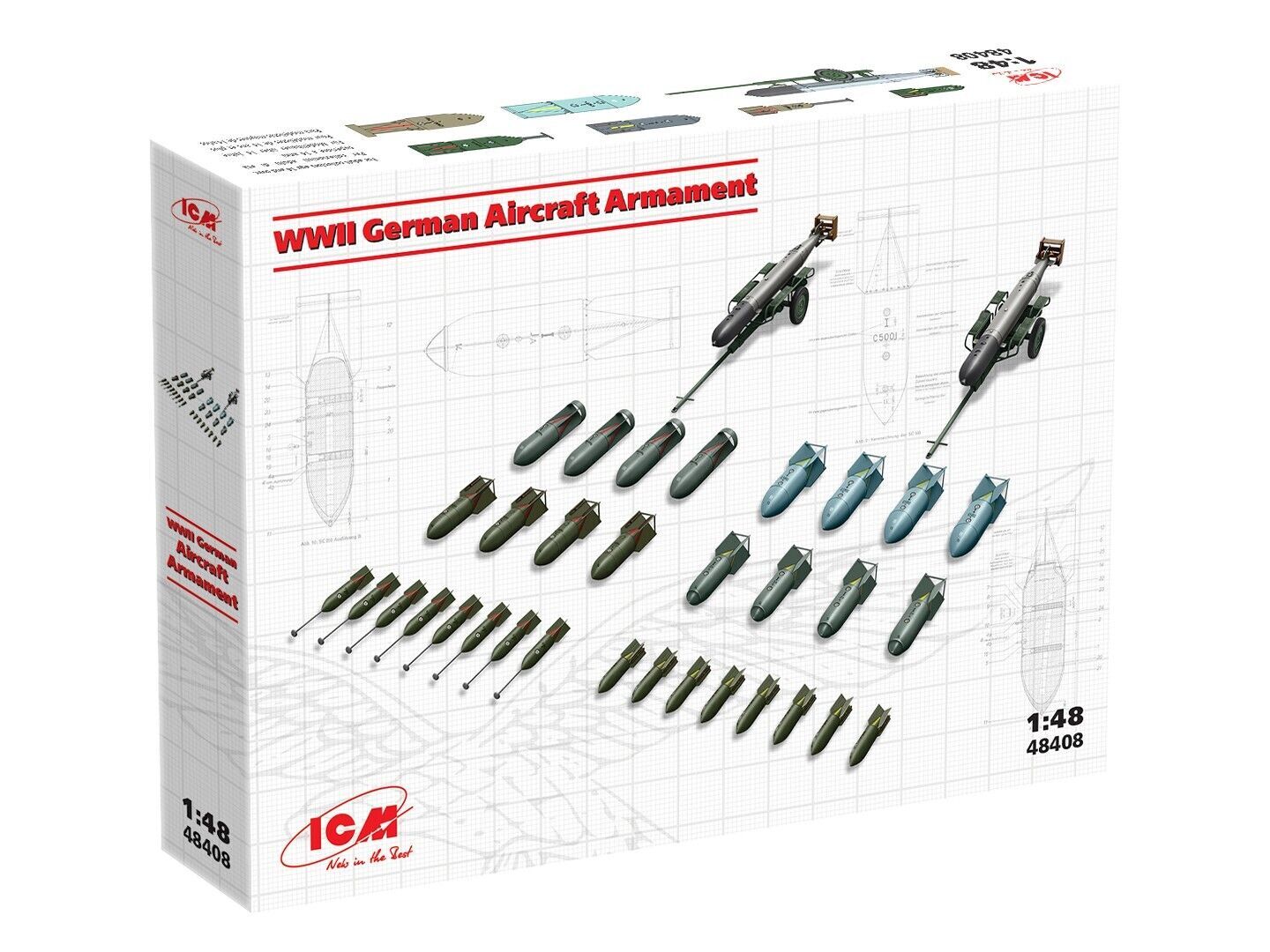
ICM 1/48 WWII German Aircraft Armament Plastic Model Kit
$32.99
or 4 payments of $8.25 with
 Info
Info
Price Matchup
Description
WWII German Aircraft Armament
Luftwaffe was armed with a large range of weapons of different types and different purposes. The main German bombs of World War II were bombs weighing 50. 250. 500. 1000. 1800 and 2500 kilograms. The most common were high-explosive bombs. They, in turn, were thin-walled, type SC and thick-walled, type SD, and had side detonators. To reduce the depth of penetration into the ground and increase the shock wave, some bombs could be equipped with a ring in the bow. Also, some bombs could have elongated detonators åÐ the so-called Dinort rods * (in German åÐ Dinort-stÌ_be), which led to a bomb explosion before the bomb itself touches the ground. Bomb carriers were both classic bombers (for example, Ju 88 or He 111), and attack aircraft or fighters, on the suspension of which bombs weighing up to 500 kilograms could be placed. Naval aviation, in addition to bombs, also used torpedoes, using them in various theaters of war åÐ in the Mediterranean, in the Atlantic and in the North of Europe.
Description
SpecificationsWWII German Aircraft Armament
Luftwaffe was armed with a large range of weapons of different types and different purposes. The main German bombs of World War II were bombs weighing 50. 250. 500. 1000. 1800 and 2500 kilograms. The most common were high-explosive bombs. They, in turn, were thin-walled, type SC and thick-walled, type SD, and had side detonators. To reduce the depth of penetration into the ground and increase the shock wave, some bombs could be equipped with a ring in the bow. Also, some bombs could have elongated detonators åÐ the so-called Dinort rods * (in German åÐ Dinort-stÌ_be), which led to a bomb explosion before the bomb itself touches the ground. Bomb carriers were both classic bombers (for example, Ju 88 or He 111), and attack aircraft or fighters, on the suspension of which bombs weighing up to 500 kilograms could be placed. Naval aviation, in addition to bombs, also used torpedoes, using them in various theaters of war åÐ in the Mediterranean, in the Atlantic and in the North of Europe.
More from this category




Description
WWII German Aircraft Armament
Luftwaffe was armed with a large range of weapons of different types and different purposes. The main German bombs of World War II were bombs weighing 50. 250. 500. 1000. 1800 and 2500 kilograms. The most common were high-explosive bombs. They, in turn, were thin-walled, type SC and thick-walled, type SD, and had side detonators. To reduce the depth of penetration into the ground and increase the shock wave, some bombs could be equipped with a ring in the bow. Also, some bombs could have elongated detonators åÐ the so-called Dinort rods * (in German åÐ Dinort-stÌ_be), which led to a bomb explosion before the bomb itself touches the ground. Bomb carriers were both classic bombers (for example, Ju 88 or He 111), and attack aircraft or fighters, on the suspension of which bombs weighing up to 500 kilograms could be placed. Naval aviation, in addition to bombs, also used torpedoes, using them in various theaters of war åÐ in the Mediterranean, in the Atlantic and in the North of Europe.
Specifications
| SKU | ICM48408 |
| Barcode # | 4823044410323 |
| Brand | ICM |
| Shipping Weight | 0.0300kg |
| Shipping Width | 0.080m |
| Shipping Height | 0.010m |
| Shipping Length | 0.080m |
Stock Location
-
Store StockBackorder
-
Warehouse StockIn Stock
Have a Question?
Price Matchup
Have a Question?
FAQ