
How Far Can an Electric RC Plane Fly?
By: Michael Snedden On: 5 November 2026
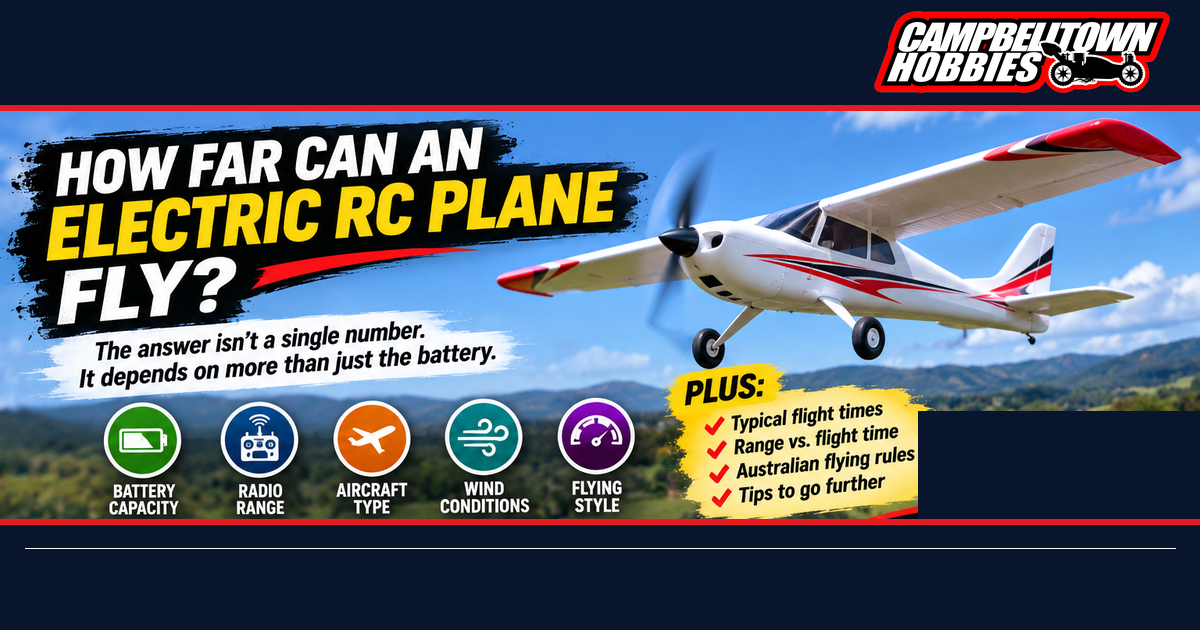

There is no single distance that applies to every electric RC plane.
How far an electric RC plane can fly depends on several things, including:
-
the radio system
-
battery capacity
-
aircraft size and efficiency
-
motor and propeller setup
-
wind conditions
-
flying speed
-
the type of aircraft
-
how clearly you can still see and control the plane
For most recreational pilots, the practical limit should not simply be “how far will the transmitter reach?”
In Australia, model aircraft must normally remain within visual line of sight, meaning you need to be able to continually see, orient and control the aircraft with your own eyes.
So while modern radio systems may technically work over considerable distances, that does not mean you should fly an electric RC plane until the radio signal disappears.
If you are choosing your first electric plane, Campbelltown Hobbies can also help match the aircraft, battery, radio equipment and level of experience rather than choosing purely on specifications.
What Does “Flying Range” Actually Mean?
This is where discussions about RC plane range can become confusing.
When someone asks, “How far can this electric plane fly?”, they may actually be asking one of three different questions.
1. How far does the radio system reach?
This is the distance over which the transmitter and receiver can maintain a reliable control connection.
2. How long will the battery keep the plane flying?
This is flight endurance.
A plane capable of remaining airborne for longer can obviously cover more distance, but flight time varies enormously between aircraft.
3. How far away can I safely fly it?
For recreational flying, this is often the most important question.
Being able to maintain control means more than having a radio signal.
You need to be able to see the aircraft clearly enough to understand its orientation, direction and position.
That makes the practical flying range considerably different from a manufacturer's theoretical radio range.
Browse the current Electric RC Planes available from Campbelltown Hobbies.
How Long Can an Electric RC Plane Fly?
Flight time varies substantially.
Some smaller trainers and sport aircraft may provide relatively short flights, while efficient electric gliders can remain airborne considerably longer.
Current Campbelltown Hobbies models demonstrate just how much variation there can be.
One FMS Easy Trainer is listed with an approximate flight time of 8 minutes.
At the other end of the spectrum, the large FMS FOX 3m electric glider is listed at around 30 minutes using its recommended battery.
Those aren't contradictory figures.
They are completely different aircraft designed for different types of flying.
This is why it is much more useful to check the specifications of the particular aircraft you are considering than to rely on a generic claim about electric plane flight time.
Why Can a Glider Fly Longer Than Some Other Electric Planes?
Aircraft design makes a huge difference.
An electric glider can use its motor to gain altitude and then reduce or shut off power while gliding.
Under favourable conditions, a pilot may also use rising air to extend the flight further.
Compare that with an EDF jet or high-performance aerobatic aircraft.
Those aircraft may spend much more of the flight using substantial motor power.
So two electric aircraft carrying good-quality LiPo batteries can still have completely different flight times.
Ask yourself:
Are you looking for maximum flight duration, or do you want speed, aerobatics or scale performance?
The answer changes the type of aircraft you should consider.
That is also where advice from a specialist hobby shop can be useful. The best electric plane is not necessarily the one with the longest advertised flight time — it is the one that suits the type of flying you actually want to do.
How Does Battery Capacity Affect Flying Range?
Battery capacity is important, but bigger does not automatically mean better.
A higher-capacity battery stores more energy.
In theory, that can extend flight time.
But a larger battery generally weighs more.
Extra weight affects:
-
take-off performance
-
climb performance
-
stall speed
-
centre of gravity
-
handling
-
motor load
-
landing characteristics
The aircraft is designed around a particular battery size, voltage and weight range.
Simply installing the largest battery that physically fits can actually make the aircraft perform worse.
Always use a battery specification suitable for the aircraft.
Campbelltown Hobbies can help match the correct battery to the aircraft rather than relying only on capacity or physical size.
Battery Voltage Matters Too
Battery capacity and battery voltage are different things.
Capacity is normally expressed in milliamp-hours, or mAh.
Voltage is determined largely by the number of cells in the battery.
For example:
-
2S
-
3S
-
4S
-
6S
Using the wrong voltage can overload the motor, ESC or other components.
This is another reason an aircraft's recommended battery specification matters more than simply choosing a battery because it has a larger capacity.
How Does Flying Style Affect Flight Time?
Two pilots flying the same aircraft with the same battery can get different flight times.
Why?
Throttle use.
A pilot cruising gently at partial throttle may use considerably less energy than someone constantly:
-
climbing at full power
-
flying fast passes
-
performing aerobatics
-
repeatedly accelerating
-
recovering from aggressive manoeuvres
Think about the way you actually fly.
If you spend most of the flight at high throttle, you should expect shorter flight times than somebody using the same aircraft for relaxed cruising.
Does Wind Affect How Far an RC Plane Can Fly?
Absolutely.
Wind can dramatically affect an electric RC plane.
Flying into a strong headwind requires more power to maintain useful groundspeed.
Flying downwind may make the aircraft travel away from you surprisingly quickly.
That creates another problem.
You still need enough battery capacity to bring it back.
A common mistake is thinking only about how far the plane has travelled away from the pilot rather than how much energy is required for the return flight.
Experienced pilots leave a sensible reserve rather than planning to land when the battery has almost nothing left.
What About Radio Range?
Modern hobby-grade radio equipment can provide excellent range, but there is no useful universal number.
Radio range can depend on:
-
transmitter and receiver combination
-
antenna positioning
-
receiver installation
-
interference
-
terrain
-
obstacles
-
radio frequency
-
aircraft orientation
-
equipment quality
The correct radio system also needs to suit the aircraft.
A small trainer and a large advanced aircraft may have very different radio requirements.
More importantly, radio range should not be treated as your target flying distance.
A control system being capable of communicating with an aircraft does not mean you can still safely see or operate it at that distance.
Visual Line of Sight Is the Practical Limit
For Australian recreational model aircraft flying, visual line of sight is particularly important.
You need to be able to continually see, orient and navigate the aircraft with your own eyes.
That means there isn't a simple answer such as:
“An electric RC plane can safely be flown exactly 500 metres away.”
A large 3-metre glider may remain visually identifiable at a greater distance than a small 600mm trainer.
Weather, lighting, background and the pilot's eyesight also make a difference.
The question shouldn't be:
“Can my radio still reach the plane?”
It should be:
“Can I still clearly see what the aircraft is doing and safely control it?”
How High Can You Fly an Electric RC Plane?
Distance isn't the only restriction to consider.
Australian model aircraft rules generally require recreational aircraft to remain below 120 metres (400 feet) above ground level unless the appropriate approval has been obtained.
Pilots also need to consider restrictions around aerodromes, people, populous areas and restricted airspace.
So owning an aircraft capable of climbing extremely quickly does not mean there are no limits on where or how high it can be flown.
Does the Type of Electric Plane Change the Range?
Very much so.
Trainer Planes
Electric trainers are generally designed around stability, predictable handling and learning rather than maximum range.
For someone starting out, being able to keep the aircraft close and clearly visible is far more useful than having enormous theoretical range.
If you are starting out, see our guide to Choosing Your First Electric RC Plane.
Electric Gliders
Gliders can be particularly efficient because they can spend significant parts of the flight with little or no motor power.
This can produce considerably longer flight times.
Sport and Aerobatic Aircraft
Sport planes trade some efficiency for manoeuvrability and performance.
How aggressively you fly them can have a major effect on battery life.
EDF Jets
Electric ducted fan aircraft can consume substantial power, particularly when flown at high throttle.
Their appeal is performance and jet-style flying rather than maximum duration.
Warbirds and Scale Aircraft
Scale aircraft can vary enormously depending on their weight, aerodynamics, power system and flying style.
There is no single range figure that applies across the category.
Can You Increase the Flying Time of an Electric RC Plane?
Yes, but the best improvements are usually about efficiency rather than simply installing a huge battery.
Things that can help include:
-
using the manufacturer-recommended battery
-
keeping unnecessary weight out of the aircraft
-
ensuring the propeller is correctly matched
-
maintaining the motor and bearings
-
keeping batteries in good condition
-
using throttle efficiently
-
flying in suitable weather
-
keeping the aircraft properly balanced
-
reducing unnecessary drag
A poorly balanced or overweight plane may need more power simply to remain flying comfortably.
Don't Ignore Centre of Gravity
Battery choice can change the centre of gravity.
That matters enormously in an RC plane.
Move too much weight forward and the plane can become excessively nose-heavy.
Move it too far rearward and the aircraft can become unstable and difficult to control.
If you are experimenting with different batteries, always check the manufacturer's recommended centre of gravity before flying.
This is another area where getting the right equipment for the particular aircraft matters more than simply buying a larger battery.
What Is the Best Electric RC Plane for a Beginner?
For beginners, maximum range should be well down the priority list.
More important features include:
-
stable flying characteristics
-
durable construction
-
manageable size
-
appropriate speed
-
electronic stabilisation where available
-
readily available spare parts
-
a suitable RTF or trainer configuration
A beginner benefits far more from an aircraft that is predictable and easy to keep close than from one designed to travel a long distance.
Campbelltown Hobbies stocks electric aircraft for different experience levels and can help narrow the choice based on whether you are completely new to RC flying, already have a transmitter and radio system, or are moving into a more advanced aircraft.
RTF, BNF or PNP?
Electric planes are sold in several configurations.
RTF — Ready-to-Fly usually provides the simplest starting point because the radio equipment and most of the required components are included and matched.
BNF — Bind-N-Fly normally requires the pilot to supply a compatible transmitter.
PNP — Plug-N-Play generally requires the pilot to supply more of the radio equipment and often the battery and charger.
Experienced pilots may prefer BNF or PNP because they already own compatible equipment.
Someone starting from scratch may find RTF considerably easier.
For a more detailed explanation, read RTF vs BNF vs PNP: Which Trainer Plane Should a Beginner Buy?.
Why Buy an Electric RC Plane From Campbelltown Hobbies?
Choosing an RC plane involves more than picking a model that looks good.
You also need to consider:
-
your flying experience
-
aircraft size
-
RTF, BNF or PNP configuration
-
transmitter compatibility
-
battery voltage and capacity
-
charger requirements
-
replacement parts
-
where and how you intend to fly
Campbelltown Hobbies specialises in RC products and stocks electric planes, batteries, radio equipment and spare parts.
That means you can get help choosing an aircraft as a complete setup rather than discovering after purchase that you still need a different transmitter, battery, charger or other equipment.
The support also matters later.
RC aircraft occasionally need replacement propellers, landing gear, control components, electronics or other parts.
Buying from a specialist hobby store gives you somewhere to return when you need help identifying a part, replacing something or moving on to your next aircraft.
You can browse the Electric RC Plane range online or speak with the Campbelltown Hobbies team about the type of flying you want to do.
How Far Should You Actually Fly?
As far as you can comfortably, legally and safely maintain positive control — not as far as the transmitter will theoretically reach.
For some aircraft and pilots, that may be relatively close.
Larger aircraft can remain easier to see at greater distances, but visual line of sight still applies.
The best flying session isn't the one where you discover the absolute limit of your radio system.
It is the one where the aircraft comes back safely with enough battery left for a controlled landing.
Summary
There is no single answer to how far an electric RC plane can fly.
Flight range depends on the aircraft, radio equipment, battery, motor system, weather and flying style.
Flight duration also varies considerably. Some electric aircraft may provide relatively short, performance-focused flights, while efficient gliders can remain airborne considerably longer.
Battery capacity can help increase endurance, but additional battery weight can also affect handling and efficiency.
Most importantly, radio range and safe flying range are not the same thing.
For recreational flying in Australia, you need to maintain visual line of sight with the aircraft and comply with the applicable operating rules.
When choosing an electric RC plane, focus on the aircraft that best suits the type of flying you actually want to do rather than simply chasing the greatest theoretical distance.
Campbelltown Hobbies can help you choose the aircraft, radio equipment, battery and accessories that work together, as well as provide spare-parts support once you are flying.
Frequently Asked Questions
What is the average flying range of an electric RC plane?
There is no meaningful universal average because aircraft size, radio equipment, battery endurance and visibility vary enormously. The practical limit is also affected by the requirement to maintain visual line of sight.
How long can an electric RC plane fly on one battery?
It depends on the aircraft. Current examples sold by Campbelltown Hobbies range from around 8 minutes for some electric models to approximately 30 minutes for a large electric glider.
Can a bigger battery make an RC plane fly longer?
It can, provided the battery is suitable for the aircraft. A larger battery also adds weight and can affect balance and performance, so the manufacturer's specifications should be followed.
Can an RC plane fly beyond the range of the transmitter?
If the aircraft loses its control link, the pilot may no longer be able to control it. Pilots should never deliberately fly towards the limit of the radio system.
Do electric gliders fly longer than normal electric planes?
They often can because they can glide with reduced or no motor power for part of the flight. Conditions and aircraft design make a major difference.
How high can you fly an electric RC plane in Australia?
Recreational model aircraft generally need to remain below 120 metres or 400 feet above ground level unless the appropriate approval has been obtained.
What is the best electric RC plane for beginners?
A stable electric trainer, preferably with forgiving handling and suitable beginner assistance features, is usually a better choice than an aircraft selected mainly for speed or range. Campbelltown Hobbies can help match the aircraft to your experience level and the equipment you already own.
Does wind reduce RC plane flight time?
It can. Strong wind may require more power and can make the return flight more difficult, particularly if the aircraft has travelled a long way downwind.
Where can I buy an electric RC plane in Australia?
Campbelltown Hobbies stocks electric RC planes, batteries, radio equipment and spare parts. You can browse online or speak with the team about selecting an aircraft and compatible equipment for your experience and flying style.


Leave a comment